
• MUSIC NOTES, INC. | 404-790-1110

Mary Wore a Red Dress

"Mary Wore a Red Dress" Lyrics, Text Format

Descending submediant arpeggio, Mi\Do\La (Em),
vocal slur, and beamed eighth notes.


Description

  • Grade: Kindergarten 
  • Origin: USA – Virginia Folk Song
  • Key: C Major 
  • Time: 2/4
  • Form: ABAC
  • Rhythm: beginners: | ta ti ti | ti ti ti ti | ta (ta) |
    | ta ta |
  • Pitches: intermediate: So La Do Re Mi So
  • Intervals: intermediate: La/Do, Mi/So8\Mi, So8\Re, Mi\Do\La descending submediant arpeggio (Em)
  • Musical Elements: notes: quarter, eighth; rest: quarter; vocal slurs, beamed eights, clapping a steady beat, submediant arpeggio 
  • Key Words: USA geography: Virginia; colors, clothing, red dress, hat, shoes, red bird

Easily adapts to a children’s game using each student’s name, clothing, hats, and shoes of different colors; where all students clap during the chorus.

“Mary Wore a Red Dress”
Verse
1. Mary wore a red dress, red dress, red dress,
Mary wore a red dress, all day long.
Chorus
Let’s all clap for Mary, Mary, Mary,
Let’s all clap for Mary, all day long.
3.
Mary wore a red hat, red hat, red hat,
Mary wore a red hat, all day long.
Chorus
4.
Mary wore her red shoes, red shoes, red shoes,
Mary wore her red shoes, all day long.
Chorus
5. Mary was a red bird, red bird, red bird,
Mary was a red bird, all day long.
Chorus
Additional Formats (click to enlarge)
music
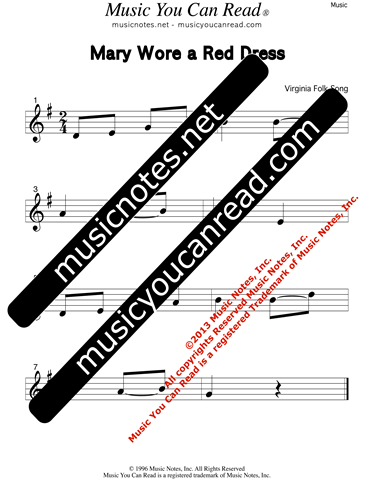
"Mary Wore a Red Dress" Music Format
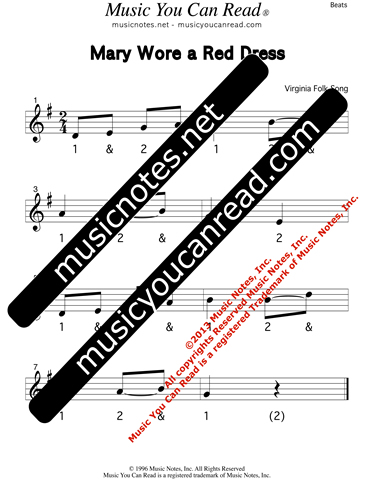
beats
Click to enlarge: "Mary Wore a Red Dress" Beats Format
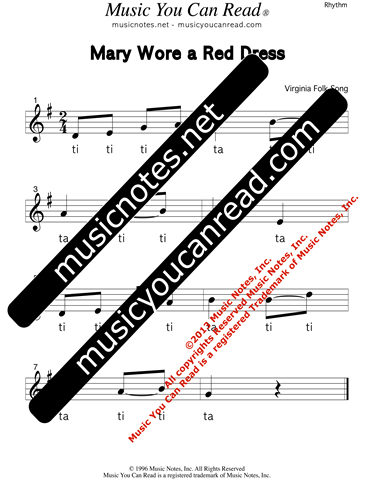
rhythm
Click to Enlarge: "Mary Wore a Red Dress" Rhythm Format
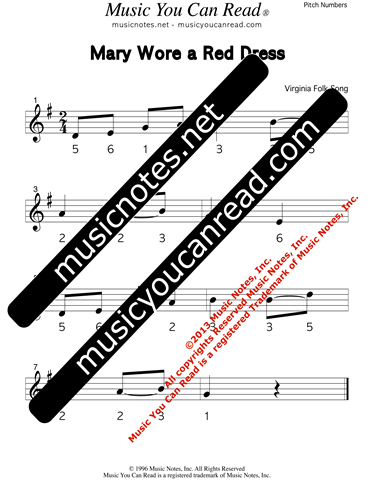
pitch numbers
Click to Enlarge: "Mary Wore a Red Dress" Pitch Number Format
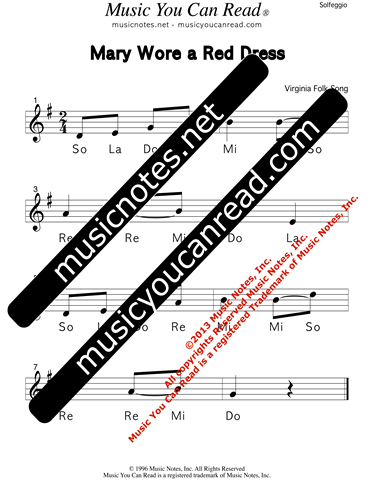
solfeggio
Click to Enlarge: "Mary Wore a Red Dress" Solfeggio Format
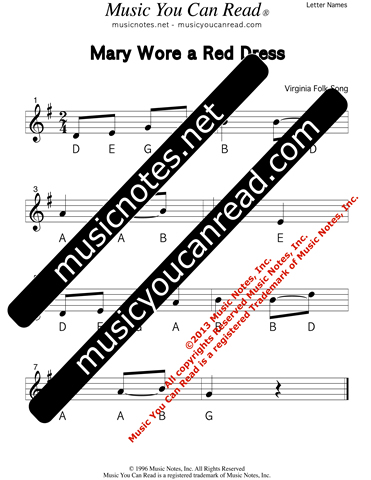
letter names
Click to Enlarge: "Mary Wore a Red Dress" Letter Names Format

Mary, Mary Quite Contrary

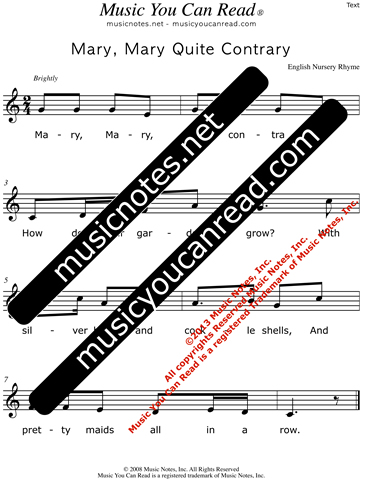
"Mary, Mary Quite Contrary" Lyrics, Text Format


A very old rhyme for your best readers!
Advanced rhythms, pitches, and intervals
create a very challenging composition.


Description

  • Grade: Kindergarten
  • Origin: England – Nursery Rhyme
  • Key: C Major
  • Time: 2/4
  • Form: ABCD
  • Rhythm: advanced: | ti ti ti ti | ti ti ri ti ti | syncopation, | ta/ ti | syncopation, | ti/ ri ti ti |
    syncopation, | ti/ ri ti ti ti ri | syncopation, | ta/ (ti) |
  • Pitches: advanced: Do Re Mi Fa So La Ti Do – the pitches of the major scale
  • Intervals: intermediate: So\Mi/So, So\Re, Fa/La, So/Do, Do\La, Ti\So, Do\Fa
  • Musical Elements: notes: dotted quarter, dotted eighth, sixteenth; rest: eighth rest; double beamed sixteenth notes
  • Key Words: world geography: England; farming, contrary, garden, grow, silver bells, cockleshells, pretty, maids, row

“Mary, Mary Quite Contrary” 

Mary, Mary, quite contrary,
How does your garden grow?
With silver bells, and cockle shells,
And pretty maids all in a row.

Additional Formats (click to enlarge)
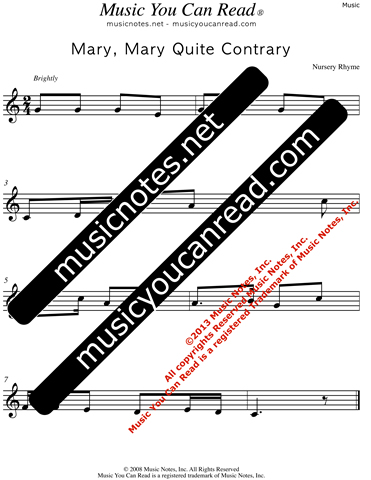
music
"Mary, Mary Quite Contrary" Music Format
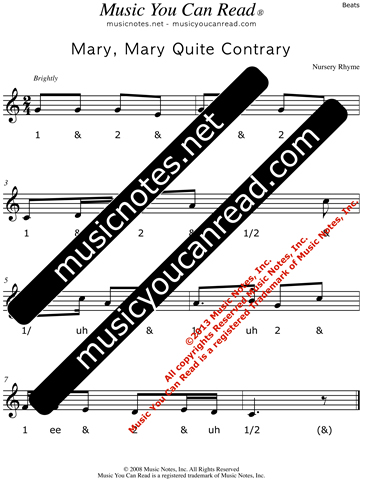
beats
Click to enlarge: "Mary, Mary Quite Contrary" Beats Format
rhythm
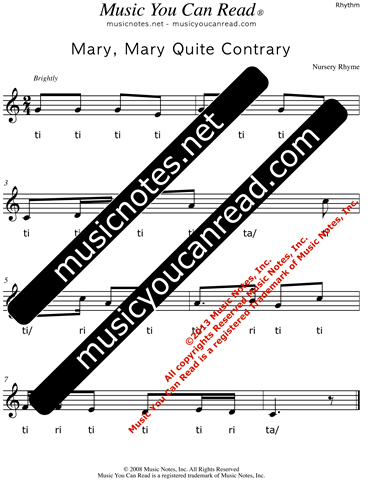
Click to Enlarge: "Mary, Mary Quite Contrary" Rhythm Format
pitch numbers
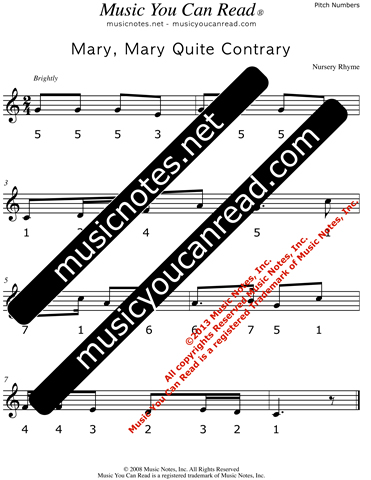
Click to Enlarge: "Mary, Mary Quite Contrary" Pitch Number Format
solfeggio
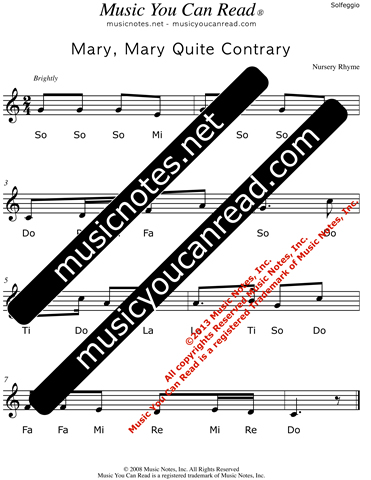
Click to Enlarge: "Mary, Mary Quite Contrary" Solfeggio Format
letter names
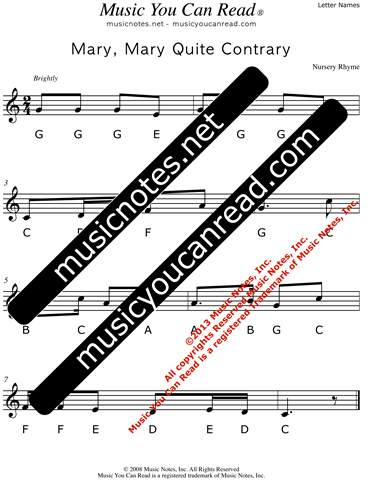
Click to Enlarge: "Mary, Mary Quite Contrary" Letter Names Format

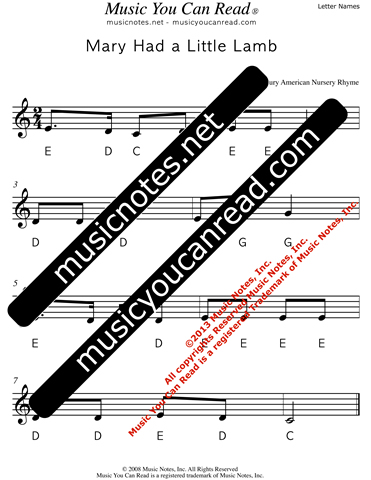
Mary Had a Little Lamb

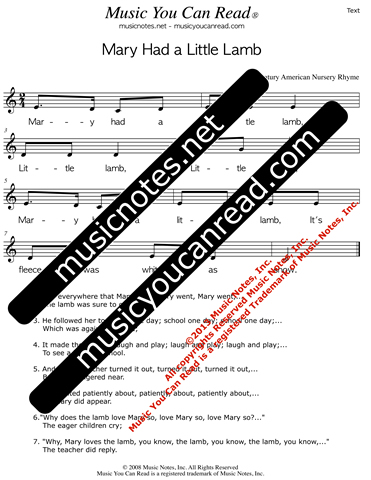
"Mary Had a Little Lamb" Lyrics, Text Format


Introducing the dotted eighth and sixteenth syncopation
and adding the tonic to the beginning Orff interval.


Description

  • Grade: Kindergarten
  • Origin: USA – 19th-century Nursery Rhyme
  • Key: C Major

  • Time: 2/4
  • Form: ABAC
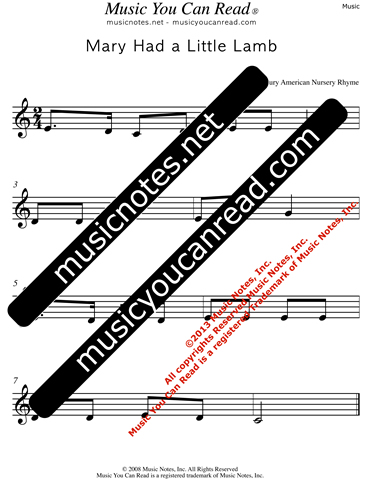
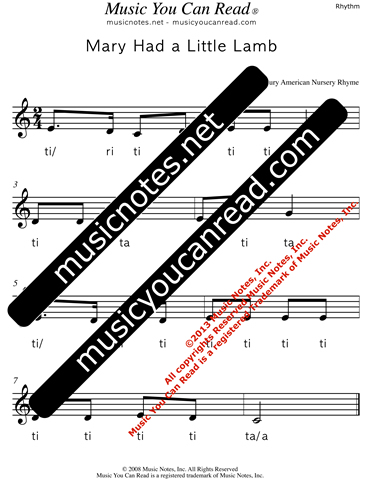
  • Rhythm: intermediate: | ti/ ri ti ti | syncopation,
    | ti ti ta | ti ti ti ti |
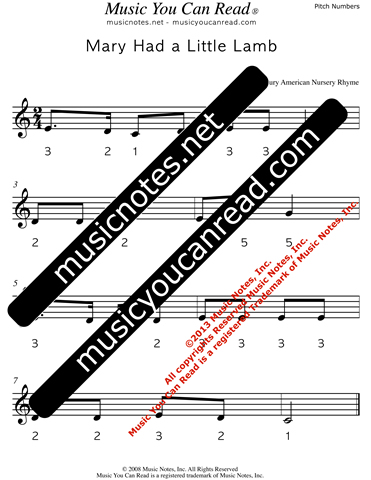
  • Pitches: beginners: Do Re Mi So
  • Intervals: beginners: Mi/So\Mi
  • Musical Elements: notes: half, quarter, dotted eighth, sixteenth, introducing sixteenth divisions, excellent for building from the beginning Orff interval, So\Mi to the tonal center, Do

  • Key Words: USA history, American nursery rhyme, school days, farming, character education, fleece, white, snow, school, rule, laugh, play, eager, children, cry, teacher
  • Keyboard: beginners: four finger exercise for right, left, and two hands together

A true story about children in Sterling, MA, USA, the original rhyme was first published by Sarah Josepha Hale on May 24, 1830. The rhyme was also the very first words recorded in the history of recorded sound by Thomas Edison.

“Mary Had a Little Lamb”

1. Mary had a little lamb,
Little lamb, little lamb,
Mary had a little lamb,
Whose fleece was white as snow.
2.
And everywhere that Mary went,
Mary went, Mary went,
And everywhere that Mary went,
The lamb was sure to go.
3.
It followed her to school one day
School one day, school one day,
It followed her to school one day,
Which was against the rules.
4.
It made the children laugh and play,
Laugh and play, laugh and play,
It made the children laugh and play
To see a lamb at school.
5. And so the teacher turned it out,
Turned it out, turned it out,
And so the teacher turned it out,
But still it lingered near.
6. And waited patiently about,
Patiently about, patiently about,
And waited patiently about
Till Mary did appear.
7. “Why does the lamb love Mary so?”
Love Mary so? Love Mary so?
“Why does the lamb love Mary so,”
The eager children cry.
8. “Why, Mary loves the lamb, you know.”
The lamb, you know, the lamb, you know,
“Why, Mary loves the lamb, you know,”
The teacher did reply.
Additional Formats (click to enlarge)
music
"Mary Had a Little Lamb" Music Format
beats
Click to enlarge: "Mary Had a Little Lamb" Beats Format
rhythm
Click to Enlarge: "Mary Had a Little Lamb" Rhythm Format
pitch numbers
Click to Enlarge: "Mary Had a Little Lamb" Pitch Number Format
solfeggio
Click to Enlarge: "Mary Had a Little Lamb" Solfeggio Format
letter names
Click to Enlarge: "Mary Had a Little Lamb" Letter Names Format

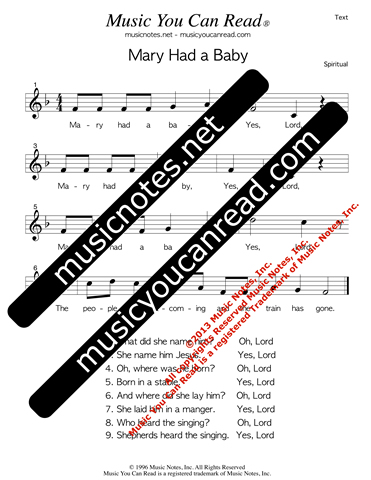
Mary Had a Baby

"Mary Had a Baby" Lyrics, Text Format


Ascending and descending melodically to the dominate, So, phrases ending with a rest on the fourth beat, and descending
arpeggios: Mi\Do\So, Mi\Do\La, La\Mi\Do.


Description

  • Grade: Third
  • Origin: USA – African American Spiritual
  • Key: F Major
  • Time: 4/4
  • Form: AaBC
  • Rhythm: beginners: | ti ti ti ti ta ta | ta/a ta (ta) |
    | ta ta ta (ta) | ta/a ta (ti) ti | syncopation,
    | ti ti ti ti ti ti ti ti | ta ta ta/a |
  • Pitches: intermediate: So Do Re Mi So La – pentatonic scale
  • Intervals: intermediate: Mi\Do\So descending tonic arpeggio, Mi\Do\La descending arpeggio, Mi/La, So\Mi, Mi\So, La\Mi\Do descending arpeggio, Do/Mi
  • Musical Elements: notes: half, quarter, eighth; rests: quarter, eighth, syncopation, arpeggios; contrasting the second staff with third staff, each passing La to reach So (ascending and descending)
  • Key Words: sacred, Christmas, spiritual, Mary, Jesus, manger, born, stable, shepherds, singing, birth of Jesus, holiday, Lord, African American history


“Mary Had a Baby”

1.Mary had a baby, Yes, Lord,
Mary had a baby, Yes, my Lord,
Mary had a baby, Yes, Lord,
The people keep a-coming and the train has gone.

2.What did she name him? Oh, Lord,
What did she name him? Oh, my Lord.
What did she name him? Oh, Lord,
The people keep a-coming and the train has gone.

3.She named him Jesus, Yes, Lord,
She named him Jesus, Yes, my Lord,
She named him Jesus, Yes, Lord,
The people keep a-coming and the train has gone.

4.Oh, where was he born? Oh, Lord,
Oh, where was he born? Oh, my Lord,
Oh, where was he born? Oh, Lord,
The people keep a-coming and the train has gone.

5.Born in a stable, Yes, Lord,
Born in a stable, Yes, my Lord,
Born in a stable, Yes, Lord,
The people keep a-coming and the train has gone.

6.And where did she lay him? Oh, Lord,
And where did she lay him? Oh, my Lord,
And where did she lay him? Oh, Lord,
The people keep a-coming and the train has gone.

7.She laid him in a manger, Yes, Lord,
She laid him in a manger, Yes, my Lord,
She laid him in a manger, Yes, Lord,
The people keep a-coming and the train has gone.

8.Who heard him singing? Oh, Lord,
Who heard him singing? Oh, my Lord,
Who heard him singing? Oh, Lord,
The people keep a-coming and the train has gone.

9.Shepherds heard him singing, Yes, Lord,
Shepherds heard him singing, Yes, my Lord,
Shepherds heard him singing, Yes, Lord,
The people keep a-coming and the train has gone.


Additional Formats (click to enlarge)
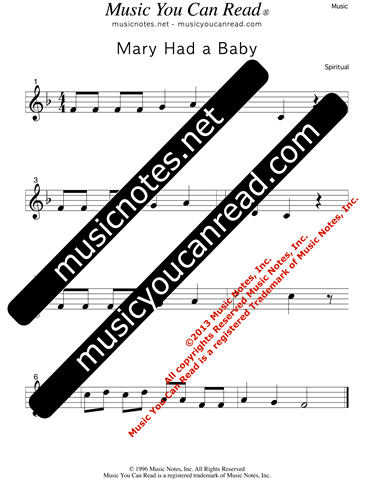
music
"Mary Had a Baby" Music Format
beats
Click to enlarge: "Mary Had a Baby" Beats Format
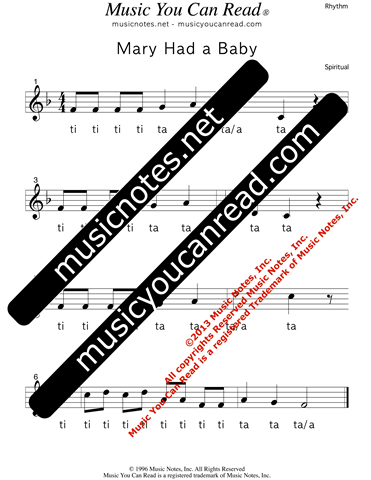
rhythm
Click to Enlarge: "Mary Had a Baby" Rhythm Format
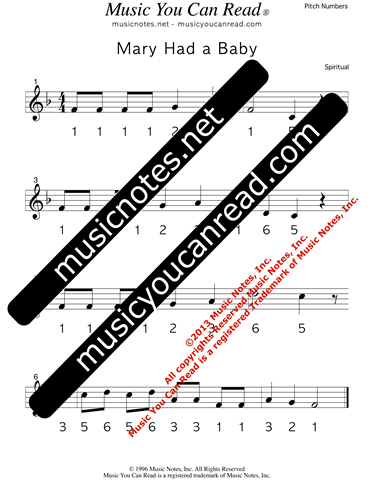
pitch numbers
Click to Enlarge: "Mary Had a Baby" Pitch Number Format
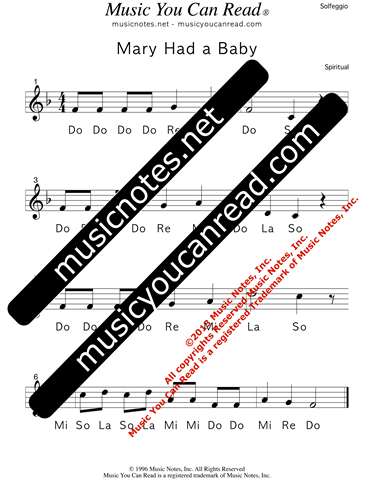
solfeggio
Click to Enlarge: "Mary Had a Baby" Solfeggio Format
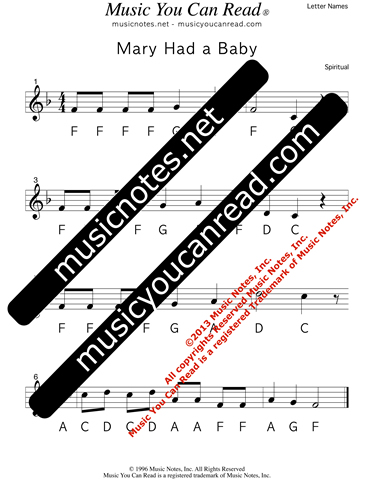
letter names
Click to Enlarge: "Mary Had a Baby" Letter Names Format

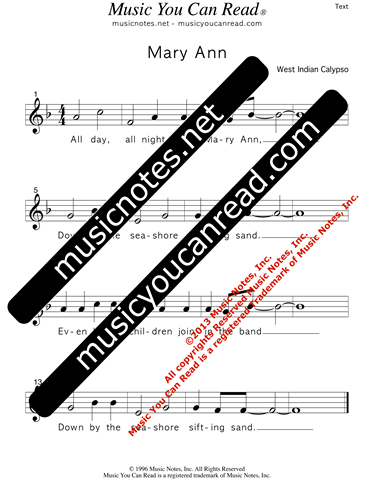
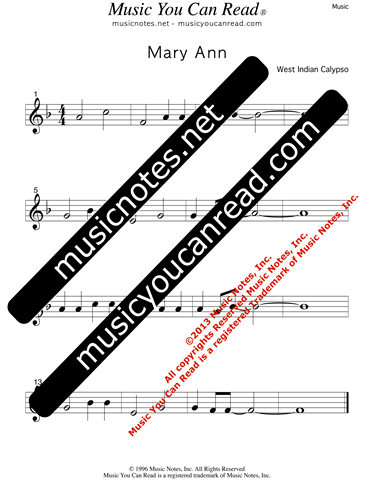
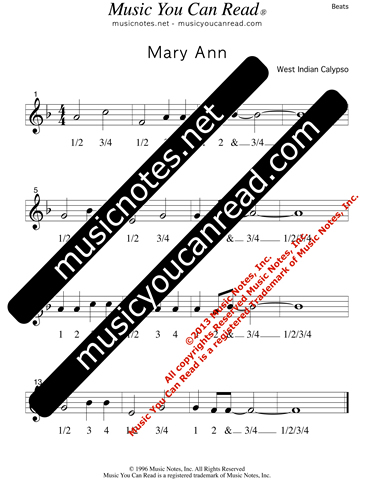
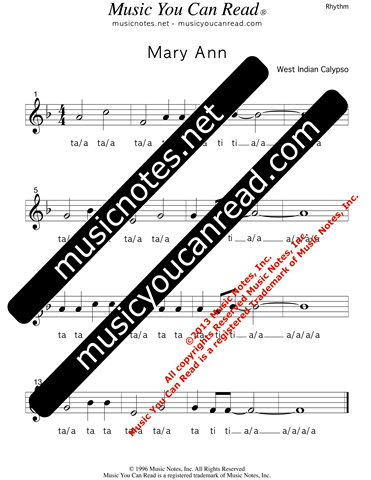
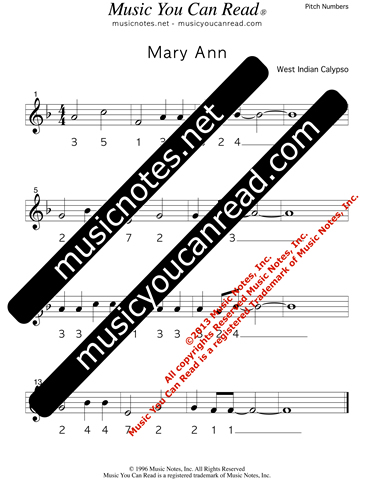
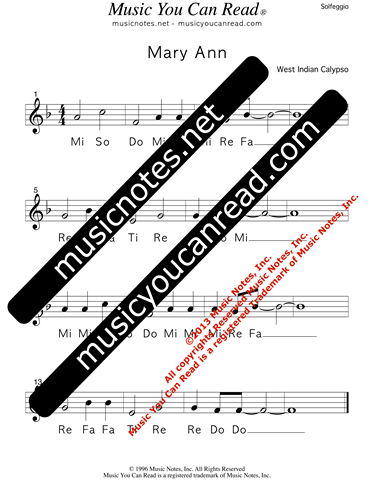
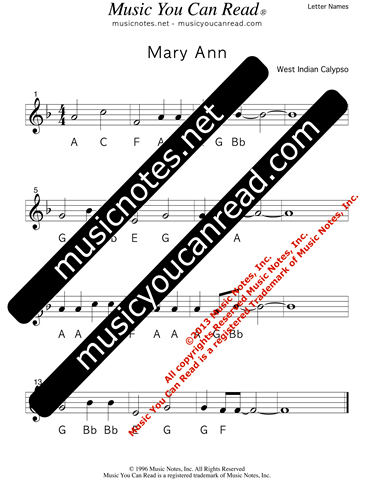
Mary Ann

"Mary Ann" Lyrics, Text Format

Excellent for reviewing notes and their values, alone or tied.
Introducing a Calypso syncopated rhythm.


Description

  • Grade: First
  • Origin: West Indian Calypso
  • Key: F Major
  • Time: 4/4
  • Form: ABab
  • Rhythm: intermediate: | ta/a ta/a | ta/a ta ta |
    | ta ti ti-a/a | ta/a/a/a | – syncopation
  • Pitches: beginners: Ti Do Re Mi Fa So
  • Intervals: intermediate: Mi/So, So\Do, Re/Fa, Fa\Ti, Ti/Re, Do/Mi
  • Musical Elements: notes: whole, half, quarter, eighth; tied notes, calypso rhythms, syncopation
  • Key Words: geography, tongue twister, calypso, Caribbean, seashore, shifting, children, band, sand


“Mary Ann”
 

All day, all night, Miss Mary Ann,
Down by the seashore shifting sand.
Even little children join in the band.
Down by the seashore shifting sand.

Additional Formats (click to enlarge)
music
"Mary Ann" Music Format
beats
Click to enlarge: "Mary Ann" Beats Format
rhythm
Click to Enlarge: "Mary Ann" Rhythm Format
pitch numbers
Click to Enlarge: "Mary Ann" Pitch Number Format
solfeggio
Click to Enlarge: "Mary Ann" Solfeggio Format
letter names
Click to Enlarge: "Mary Ann" Letter Names Format

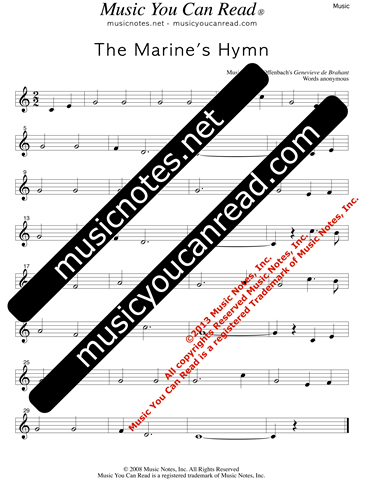
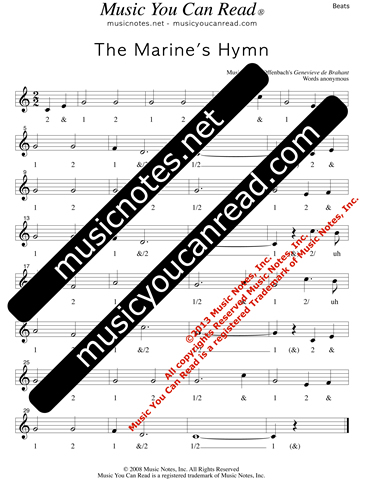
The Marine’s Hymn

"The Marine's Hymn," Lyrics, Text Format

Syncopation in 2/2, cut time, tonic octave skip
Do/Do, tonic arpeggios, subdominant arpeggio, and eight
measure phrases promote breath support for voice and recorder.


Description

  • Grade: Fifth
  • Origin: USA – Marine Corps Hymn, circa. 1917
    music: Jacques Offenbach’s “Geneviève de Brabant,” revised 1867
  • Key: C Major
  • Time: 2/2 cut time
  • Form: AABbA
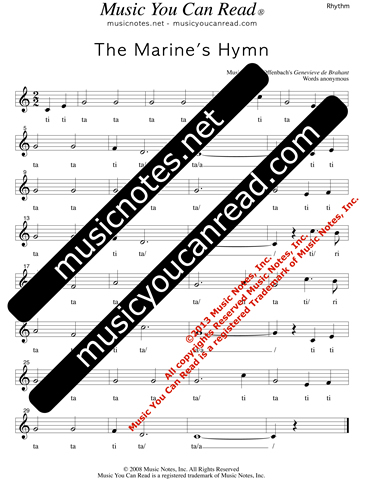
  • Rhythm: intermediate: | ta ta | ta/ ti | syncopation, | ti ta/ | syncopation, | ta/a |
    | ta (ta) ta ta | ta ti ti | ta (ta) ti/ ri | syncopation,
    | ta ti/ ri | syncopation
  • Pitches: intermediate: Do Re Mi Fa So La Ti Do
  • Intervals: intermediate: Do/Mi/So ascending tonic arpeggio (I, C), So/Do8 (P4) Do8\So\Mi descending tonic arpeggio (I, C), Do/Do8 ascending tonic octave skip, La\Fa (M3), Fa/La/Do ascending subdominant arpeggio (IV, F), So/Do8\So (P4)
  • Musical Elements: notes: whole, dotted half, half, dotted quarter, quarter, eighth; rest: quarter; pickup beat, tied notes, 2/2 – cut time syncopation, tonic octave skip, tonic arpeggios, subdominant arpeggio, eight measure phrases promote breath support
  • Key Words: USA history, USA Armed Services, US Marines, Marine Corps Hymn, “Rhymes of the Rookies” published in 1917 by W.E. Christian, world history/geography: Jacques Offenbach ( 1819-1880) German Romantic composer, Halls of Montezuma, Tripoli, patriotism, patriot, freedom, honor, proud, claim, title, United States Marines, unfurled, breeze, dawn, tropic scenes, always, health, serve, strife, nerve, Army, Navy, guarded; contractions: flag’s (flag is) , here’s (here is), we’ve (we have); abbreviations: clime (climate) , possessive: Heaven’s
  • Recorder: intermediate: C/C tonic octave skip, C/E/G, C\G\E tonic arpeggios, and F/A/C subdominant arpeggio, note: eight measure phrases promote breath support


“The Marine’s Hymn”
 
1.
From the Halls of Montezuma,
To the shores of Tripoli;
We fight our country’s battles
In the air, on land, and sea;
First to fight for right and freedom
And to keep our honor clean:
We are proud to claim the title
Of United States Marine.
2.
Our flag’s unfurled to every breeze
From dawn to setting sun;
We have fought in every clime and place
Where we could take a gun;
In the snow of far-off Northern lands
And in sunny tropic scenes;
You will find us always on the job
The United States Marines.
3. Here’s health to you and to our Corps
Which we are proud to serve;
In many a strife we’ve fought for life
And never lost our nerve;
If the Army and the Navy
Ever look on Heaven’s scenes;
They will find the streets are guarded
By United States Marines.
Additional Formats (click to enlarge)
music
"The Marine's Hymn," Music Format
beats
Click to enlarge: "The Marine's Hymn," Beats Format
rhythm
Click to Enlarge: "The Marine's Hymn," Rhythm Format
pitch numbers
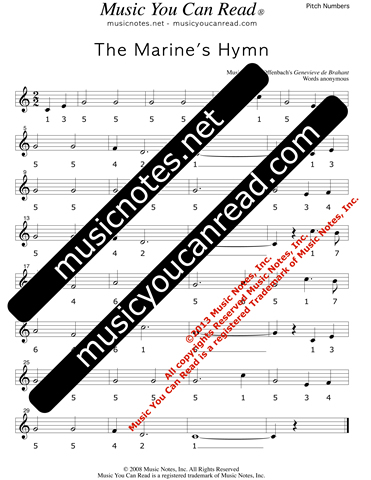
Click to Enlarge: "The Marine's Hymn," Pitch Number Format
solfeggio
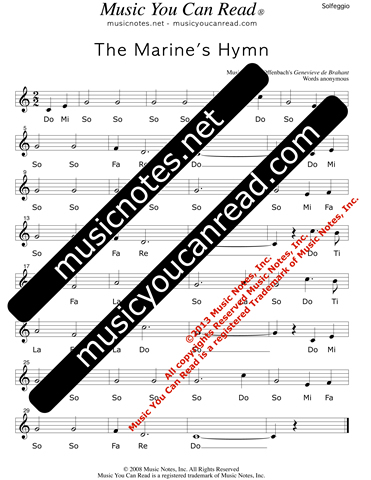
Click to Enlarge: "The Marine's Hymn," Solfeggio Format
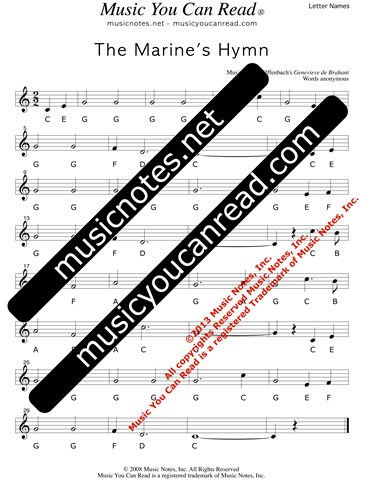
letter names
Click to Enlarge: "" Letter Names Format

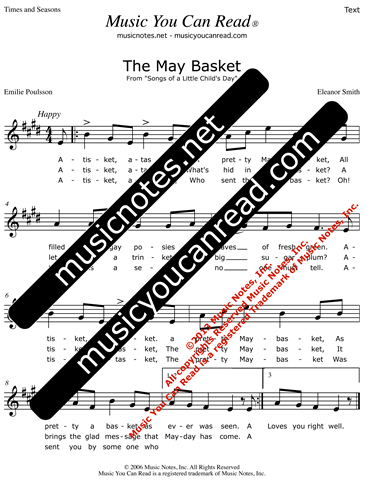
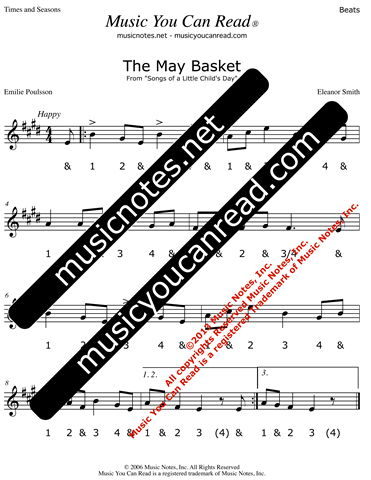
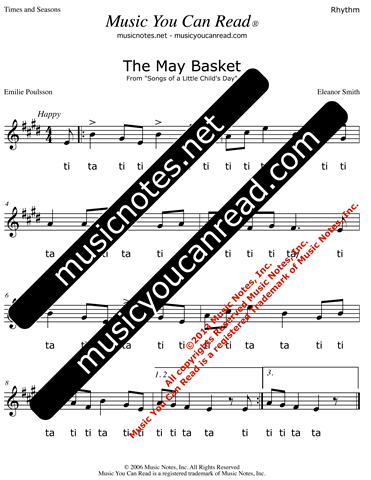
The May Basket

"Down by the Bay" Lyrics, Text Format

Introducing the horizontal accent with a perfect fifth.


Description

  • Grade: First
  • Origin: Emilie Poulsson, Eleanor Smith
  • Key: E Major
  • Time: 4/4
  • Form: ABAC
  • Rhythm: intermediate: | ta ti ti ta ti ti |
    | ti ti ta ta ti ti | ti ti ti ti ta/ ti | ti ti ta ta (ti) ti |
  • Pitches: intermediate: Do Re Mi Fa So La Do
  • Intervals: intermediate: Do/So, So\Mi, Mi\Do, Do/Fa, La/Do, Do\So, Fa\Re, Re/So
  • Musical Elements: notes: dotted quarter, quarter, eighth; rest: eighth; horizontal accent (play/sing the note louder), pickup beat, repeat signs, multiple endings
  • Key Words: Easter, holiday songs, Spring songs, flowers, basket, posies, leaves, green, sugar-plum, May Day, secret, right well, seasons


“The May Basket”
 
1.
A-tisket, a-tasket, A pretty May basket,
All filled with gay posies and leaves of fresh green.
A-tisket, a-tasket, The pretty May basket,
As pretty a basket as ever was seen.
2.
A-tisket, a-tasket, What’s hid in the basket?
A letter, a trinket, or big sugar-plum?
A-tisket, a-tasket, The pretty May basket,
It brings the glad message that May-day has come.
3. A-tisket, a-tasket, Who sent the May basket?
Oh! that is a secret that no one must tell.
A-tisket, a-tasket, The pretty May basket
Was sent you by someone who loves you right well.
Additional Formats (click to enlarge)
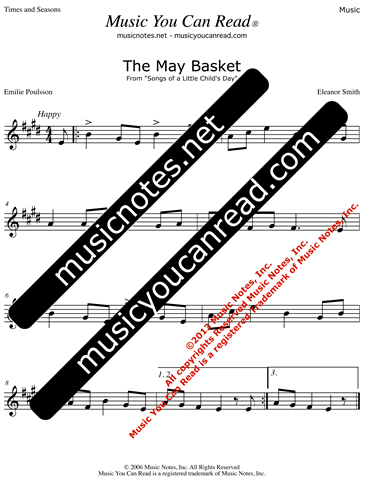
music
"Down by the Bay" Music Format
beats
Click to enlarge: "Down by the Bay" Beats Format
rhythm
Click to Enlarge: "Down by the Bay" Rhythm Format
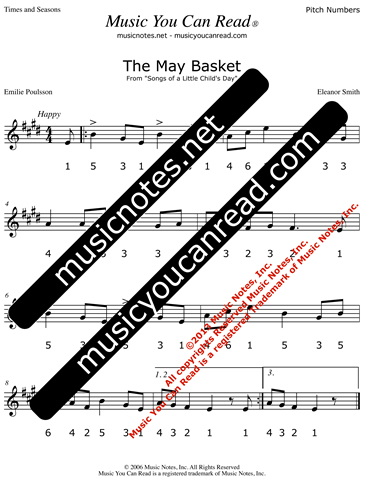
pitch numbers
Click to Enlarge: "Down by the Bay" Pitch Number Format
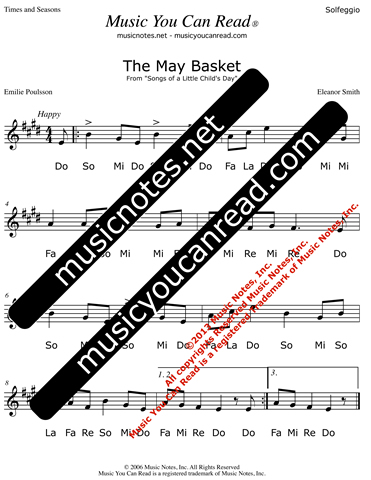
solfeggio
Click to Enlarge: "Down by the Bay" Solfeggio Format
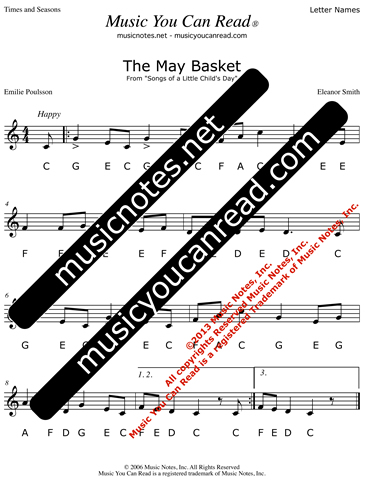
letter names
Click to Enlarge: "Down by the Bay" Letter Names Format

The Man on the Flying Trapeze

"The Man on the Flying Trapeze" Lyrics, Text Format

Beginning syncopation with an interval of a minor sixth.


Description

  • Grade: Third
  • Origin: USA, words: Joe Saunders (stage name: George Leybourne – music: Gaston Lyle
  • Key: G Major
  • Time: 3/4
  • Form: ABAC*
  • Rhythm: beginners: | ta ta ta | ta/a ti ti | syncopation, | ta ti/ ti | syncopation, | ta/a/a |
  • Pitches: beginners: So La Ti Do Re Mi Fa
  • Intervals: intermediate: So/Do, Fa\La (m6), La/Re,
    Re\So, Do\La
  • Musical Elements: notes: dotted half, half, dotted quarter, quarter, eighth; pickup beat, tied notes
  • Key Words: ballad, circus acts, through, greatest, ease, daring, trapeze, actions, graceful, stolen away; contraction: he’d (he would)

* Chorus of 19th century popular song.


“The Man on the Flying Trapeze”
 

He’d fly through the air with the greatest of ease.
The daring young man on the flying trapeze,
His actions are graceful, all girls he does please,
And my love he has stolen away.
Additional Formats (click to enlarge)
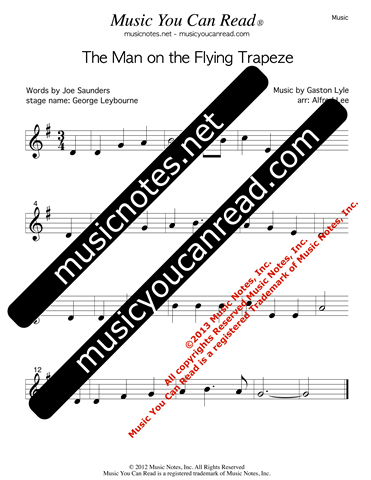
music
"The Man on the Flying Trapeze" Music Format
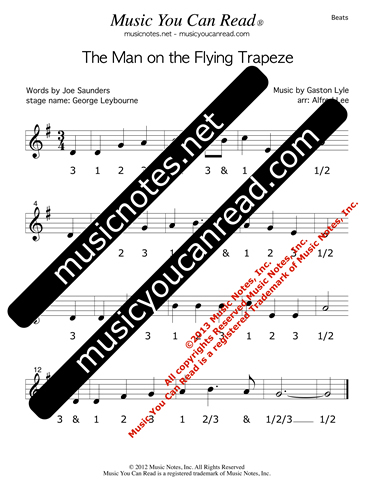
beats
Click to enlarge: "The Man on the Flying Trapeze" Beats Format
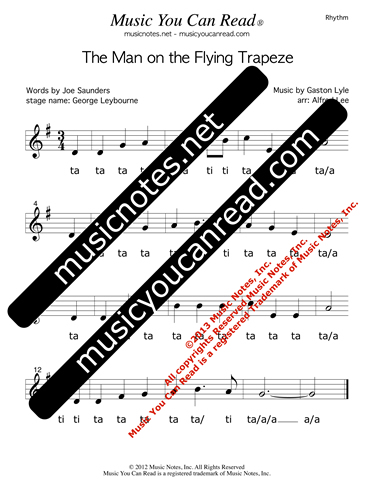
rhythm
Click to Enlarge: "The Man on the Flying Trapeze" Rhythm Format
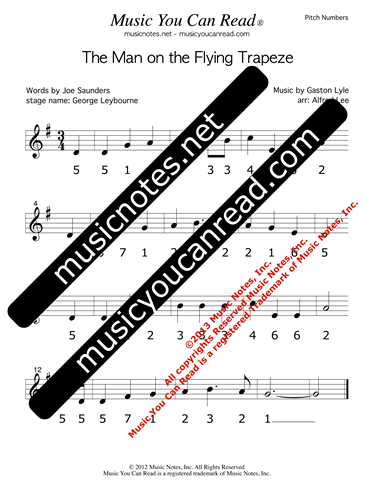
pitch numbers
Click to Enlarge: "The Man on the Flying Trapeze" Pitch Number Format
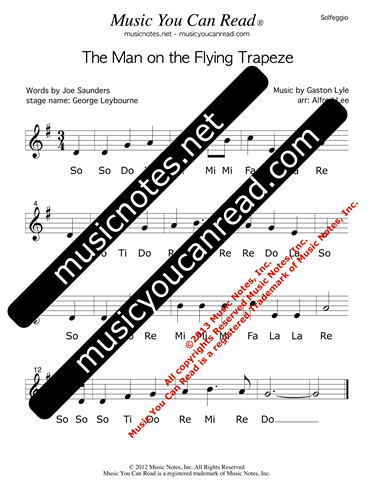
solfeggio
Click to Enlarge: "The Man on the Flying Trapeze" Solfeggio Format
letter names
Click to Enlarge: "The Man on the Flying Trapeze" Letter Names Format

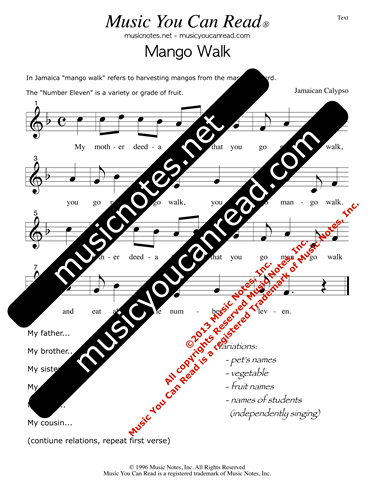
Mango Walk

"Mango Walk" Lyrics, Text Format

Advanced descending interval: Fa\So, ascending arpeggio So/Ti/Re, and syncopated African rhythms make this Calypso
challenging and lots of fun!


Description

  • Grade: Third
  • Origin: Jamaica – Calypso Song
  • Key: F Major
  • Time: 4/4 – common time
  • Form: ABAb
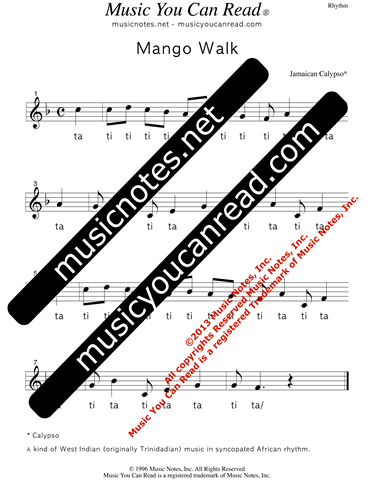
  • Rhythm: intermediate: | ti ti ti ti ti ti ti ti |
    | ti ta ti ta ta | syncopation, | ti ta/ (ta) ta | syncopation
  • Pitches: intermediate: So Ti Do Re Mi Fa So La
  • Intervals: advanced: Do/Mi, Mi\So, So/Do, Do/So, Re/Fa, Fa\So, So/Ti/Re ascending arpeggio
  • Musical Elements: notes: dotted quarter, quarter, eighth; rest: quarter; pickup beat, syncopation, ascending arpeggio
  • Key Words: world geography, Jamaica, Trinidad, calypso, African rhythms, harvesting mangos, deed (did); family relations: father, mother, brother, sister, uncle, aunt, cousin; abbreviation: ‘leven (eleven), multi-cultural music

“Mango Walk” 

1. My mother deed-a tell me that you go mango walk,
go mango walk, go mango walk.
My mother deed-a tell me that you go mango walk,
and eat all the number ‘leven.
2.
My father deed-a tell me that you go mango walk,
go mango walk, go mango walk.
My father deed-a tell me that you go mango walk,
and eat all the number ‘leven.
3. My brother deed-a tell me that you go mango walk,
go mango walk, go mango walk.
My brother deed-a tell me that you go mango walk,
and eat all the number ‘leven.
4. My sister deed-a tell me that you go mango walk,
go mango walk, go mango walk.
My sister deed-a tell me that you go mango walk,
and eat all the number ‘leven.
5. My uncle deed-a tell me that you go mango walk,
go mango walk, go mango walk.
My uncle deed-a tell me that you go mango walk,
and eat all the number ‘leven.
6. My aunt she deed-a tell me that you go mango walk,
go mango walk, go mango walk.
My aunt she deed-a tell me that you go mango walk,
and eat all the number ‘leven.
7. My cousin deed-a tell me that you go mango walk,
go mango walk, go mango walk.
My cousin deed-a tell me that you go mango walk,
and eat all the number ‘leven.
Calypso: West Indian (originally Trinidadian) music in syncopated African rhythms.
Mango Walk: refers to harvesting mangos from the mango orchard.
Number Eleven: a variety or grade of fruit.
Additional Formats (click to enlarge)
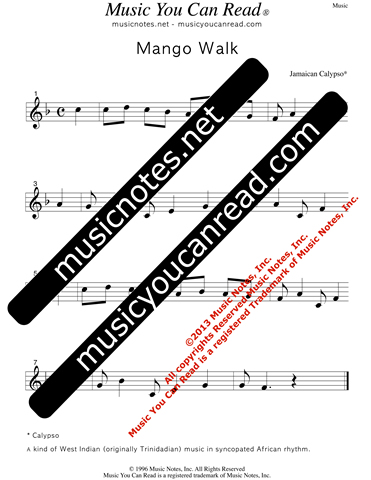
music
"Mango Walk" Music Format
beats
Click to enlarge: "Mango Walk" Beats Format
rhythm
Click to Enlarge: "Mango Walk" Rhythm Format
pitch numbers
Click to Enlarge: "Mango Walk" Pitch Number Format
solfeggio
Click to Enlarge: "Mango Walk" Solfeggio Format
letter names
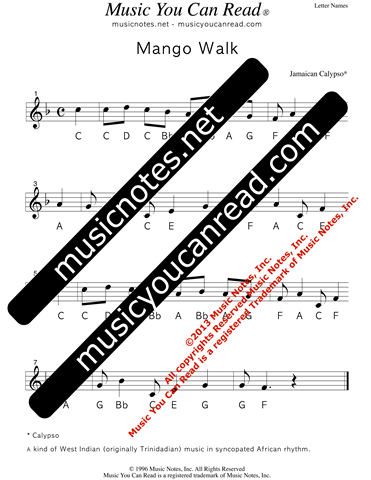
Click to Enlarge: "Mango Walk" Letter Names Format

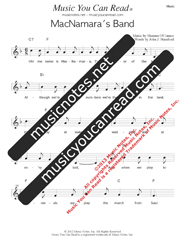
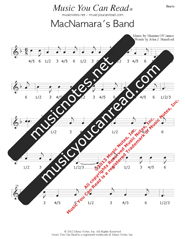
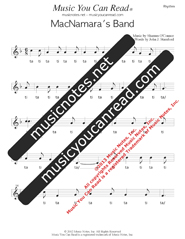
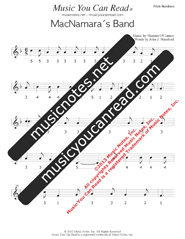
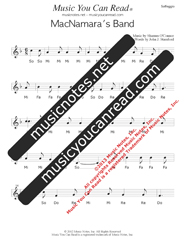
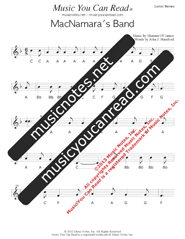
MacNamara’s Band – New

MacNamara's Band Text Format
MacNamara's Band Additional Languages

Feeling of duple meter in 6/8.


Description

  • Grade: Fifth (5)
  • Origin: Ireland – Music: Shamus O’Connor – Words: John J Stamford – circa 1889
  • Key: F Major
  • Time: 6/8
  • Form: ABAbCBDb
  • Rhythm: intermediate: | ta ti ti ti ti | ta ti ta ti | ti ti ti ti ti ti | ta/a/ ti | ta ti ta ti | ta/ ta/ | ti ti ti ta/ ti | ta/ ta ti |
  • Pitches: advanced: So Do Re Mi Fa So
  • Intervals: intermediate: So\Mi (m3), Do\So (P4), So/Mi M6), So8\Do (P5)
  • Musical Elements: • notes: dotted quarter, quarter, eighth; rests: none; running eighth notes, syncopation, feeling of duple meter in 6/8 where one beat is equal to a dotted quarter, tied notes, rhythm changes with verse syllables
  • Key Words: • Ireland, St. Patrick’s Day, leader of the band, although, finest, wakes, weddings, funerals, march from Saul, rehearsing, affair, annual, celebration, gentry, General Grant, Uncle Yulis, Sweden, march, ladies, grand, shout, Irish band, bunch, shamrocks, uniform, funniest, Swede, McCarthy, O’Brians, Ryans, Sheehans, Meehans, Hennessey, Tennessee, yimminy, clang, credit, blaze, pumps, tootles, musical instruments: bass drum, drums, cymbals, bazoon, bagpipes, flute


“MacNamara’s Band”

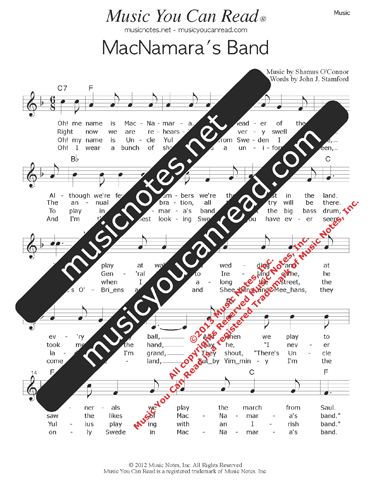
1 Oh!, me name is McNamara, I’m the leader of the band,
Although we’re few in numbers we’re the finest in the land.
We play at wakes and weddings, and at every fancy ball,
And when we play at funerals we play the march from Saul.
Chorus:
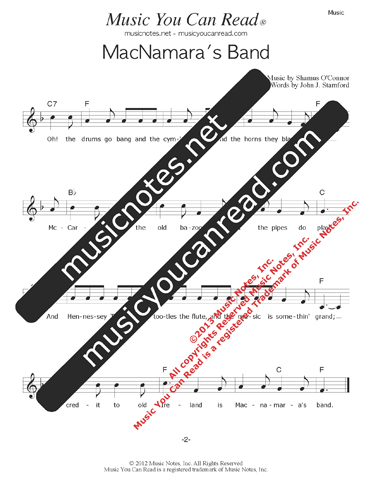
Oh! the drums go bang, and the cymbals clang,
and the horns they blaze away,
McCarthy pumps the old bazoon while I the pipes do play;
And, Hennessey Tennessey tootles the flute,
and the music is somethin’ grand,
A credit to old Ireland is McNamara’s Band!
2 Right now we are rehearsin’ for a very swell affair,
The annual celebration, all the gentry will be there.
When General Grant to Ireland came, he took me by the hand,
Says he, “I never saw the likes of McNamara’s Band.”
Chorus
3 Oh my name is Uncle Yulis and from Sweden I have come,
To play with McNamara’s Band and beat the big bass drum,
And when I march along the street the ladies think I’m grand,
They shout “There’s Uncle Yulis playing with an Irish band.”
4 Oh! I wear a bunch of shamrocks and a uniform of green,
And I am the funniest looking Swede that you have ever seen.
There’s O’Briens and Ryans and Sheehans and Meehans,
they come from Ireland,
But by Yimminy I’m the only Swede in McNamara’s Band.
Chorus
Additional Formats (click to enlarge)
music
Click to enlarge: MacNamara's Band Music Format
beats
Click to enlarge: MacNamara's Band Beats Format
rhythm
Click to Enlarge: Click to enlarge: MacNamara's Band Rhythm Format
pitch numbers
Click to Enlarge: MacNamara's Band Pitch Number Format
solfeggio
Click to Enlarge: MacNamara's Band Solfeggio Format
letter names
Click to Enlarge: MacNamara's Band Letter Names Format